What Is Maslow’s Hierarchy of Needs?
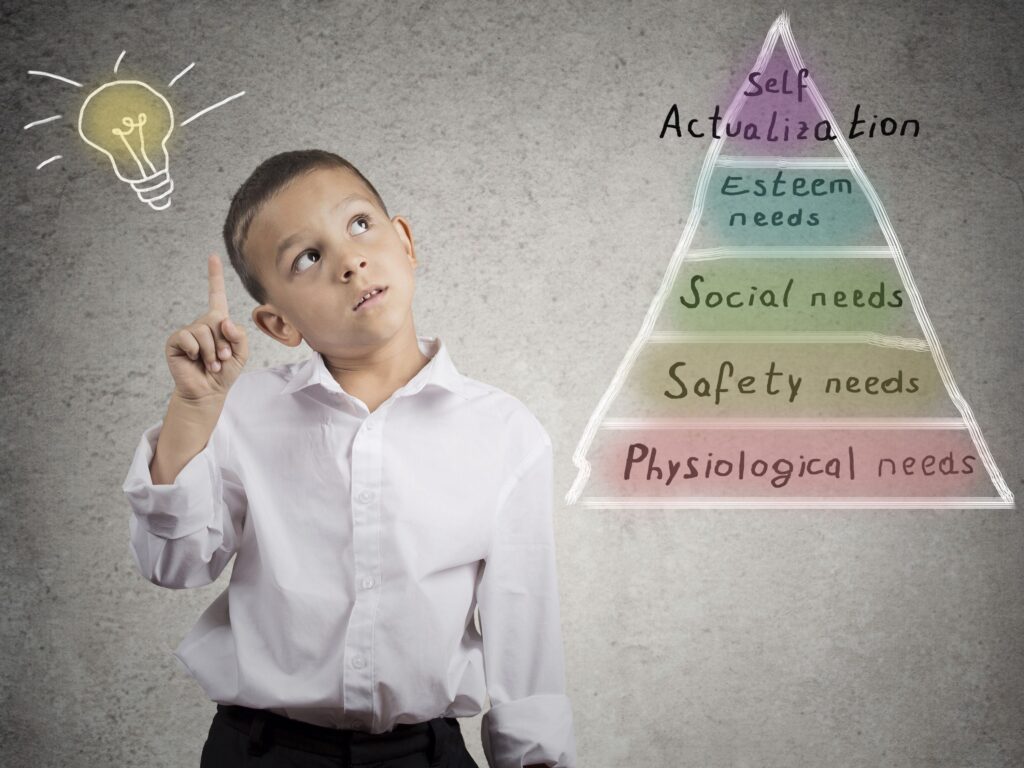
Maslow’s Hierarchy of Needs is a motivational theory in psychology comprising a five-tier model of human needs, often depicted as hierarchical levels within a pyramid.
The needs are:
- Physiological
- Safety
- Love and belonging
- Esteem
- Self-actualization
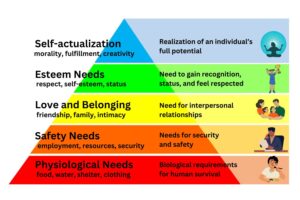
The bottom of the pyramid comprises physiological needs, whereas self-actualization can be found at the top. The basis for this theory is that people can only attend to their higher needs, like esteem and self-actualization once their basic needs (physiological and safety) are met. Maslow believes that when our needs have been satisfied, they eventually go away, and then we can focus on meeting the next set of needs. The higher the pyramid you go, the more challenging it is to meet those needs.
Examples of each need:
Physiological: food, water, shelter, clothing, sleep
Safety: good health, job security, money, property
Love and belonging: friends, family, intimacy, sense of community
Esteem: confidence, respect
Self-actualization: creativity, acceptance, enlightenment

Looking for a graduate program?
Deficiency Needs Vs. Growth Needs
Maslow also breaks up this model into deficiency needs (D-needs) vs. growth needs (B-needs). Physiological, safety, love and belonging, and esteem are all classified as D-needs. They stem from a lack of something, and the longer a person is lacking, the stronger these needs become. The stronger the needs become, the more motivated the person is to fulfill them. For example: the longer a person goes without food, the hungrier they will become and the harder they will try to obtain some. They won’t be able to focus on needs higher up in the pyramid, like love and self-esteem, until their need for food has been met.
Self-actualization is considered a B-need because it does not come from a deficiency. Rather, it comes from a need to grow as a person. And unlike D-needs, once a B-need has been satisfied, it does not go away. Instead, the need will become even stronger. D-needs only go away once a person reaches a high level of self-actualization.
It’s important to note that not all people move through this hierarchy unilaterally. Life happens, and life events such as death, loss of employment, divorce, etc., will interrupt a person’s ability to move from one level to another. They may bounce back and forth several times throughout the pyramid during their lifetime in their attempt to reach self-actualization.
Maslow’s Hierarchy of Needs in Education
It’s no secret that students are often distracted in the classroom. In order for them to truly be engaged in learning, these distractions need to be addressed and dealt with, either by themselves, their parents, or their teachers. Maslow’s Hierarchy of Needs is essential to identify and remove these distractions from students’ lives so they can focus on making their education their number one priority.
Below is a list of how schools and teachers can address the pyramid of needs with their students:
Physiological Needs – Food, Shelter, Clothing, Etc.
Many schools offer free and reduced lunch programs. A student cannot learn if they are hungry; their mind will be entirely preoccupied with food. Once this need is met, it will be easier for them to concentrate on learning. Some schools will allow teachers to provide students with snacks or with a break to eat a snack brought from home. They can also control the temperature of the classroom and the lighting to ensure students are learning in a comfortable environment. Occasionally schools will run a clothing and a hygiene drive to make sure their students have access to these essential items.
Safety
While it may be close to impossible to ensure students feel safe at home, safety is definitely something that teachers can enforce in their classrooms. Consistency and routine is the best way to ensure that students feel safe in the classroom. There should be consistent rules that are enforced throughout the year, as well as classroom routines, and both these things should be communicated to students repeatedly. That way students know exactly what they can expect from their teacher and their classroom environment. This type of consistency can do wonders for a student’s mental health, especially when they may have a more erratic home life. Teachers can also monitor their classrooms to make sure they’re free of bullying, and they can cultivate healthy, open-minded discussions among their students.
Love, Belonging, and Esteem
Students may be able to have these needs met through appreciation and gratification from their teacher and peers. Teachers should work hard to get to know each student individually, and then make an effort to praise them for their strengths and uniqueness. Not all students will receive this type of individualized attention at home, and so it is imperative that their teacher make an effort to build up their confidence in the classroom. In addition, maintaining rules and routines in the classroom can help with this level of need as well. Students should always be respectful of one another, and teachers should work to make sure their classrooms are inclusive to all students.
Self-Actualization
Teachers typically handle the four deprivation needs in the classroom, and once these needs are satisfied, students can work towards self-actualization. Teachers can foster this need by stimulating students’ minds with in-depth discussion topics and encouraging peer tutoring and coaching.
Teachers have the power and the responsibility to make major changes in the lives of their students; they can do this by familiarizing themselves with Maslow’s Hierarchy of Needs, and then working hard to ensure their students’ needs are being met within the classroom.
Educators never stop learning; check out our available graduate degree programs to hone your skills and promote lifelong learning and academic excellence.