
What is the Grading for Learning Framework?
If you want to get a debate among educators, broach the subject of grading. Grading is a hot-button issue for many adults in education. We always talk about making decisions in the best interest of our students, but then we turn around and hand out zeros or “F’s” when our expectations or timelines have not been met. Authors such as Ken O’Connor, believe that placing importance on measures such as these unfairly punishes students, which is why he promotes Grading for Learning.
Simply stated, grading for learning is the process where educators use formative assessments to drive instructional practices. Grading for learning focuses on providing feedback to students, so their knowledge of a subject grows over time. Grades are not permanent (even summative assessments). But many educators say they must abide by one-chance testing and deadlines because they are preparing students for “the real world”.
The world I live in is full of second chances. Let’s also mention how we give grades. I have seen grades handed out based on things such as class participation, attendance, volunteering to lead a small group, and turning in work early. The problem with these practices is that you are really assigning a grade for behavior, not comprehension of knowledge.
How to Incorporate Grading for Learning
Instead of practicing grading traditionally (the teacher teaches content, and all students take a one-time standardized test) here are some suggestions to be more innovative with your grading system:
Focus on Standards-Based Grading
It seems logical that students would learn and be assessed on content aligned with their grade level standards, but this is not always the case. Over the years, I have seen teachers teach content based on their fondness for a project or book that has nothing to do with grade-level standards, but these lessons are ones they have taught or used for years.
What about communication of grades with families? Ideally, any type of progress report/report card that goes home with students will have a breakdown of how the student performed on knowledge-based assessments for each standard taught. Elementary schools do a great job with standards-based communication. Our secondary friends need to catch up.
Allow Retakes
If a student did not do well on a summative assessment, my school had a system in place to allow students to retake the assessment. Many colleagues have the same reaction when I tell them about this plan, “if students are allowed to retake a summative assessment, they just will not study the first time and bury the teacher in paperwork with retakes.”
To address this issue, we created relearning contracts. If a student wished to retake a summative assignment (we did not allow retakes of formative assignments), they had to fill out a form that outlined the extra work the student would do between the first and second opportunities. The student had their parents/guardians sign the paper and then the student and teacher reviewed it together.

Looking for a graduate program?
The idea is that when students realize the extra work, they must complete to get a retake, they will realize that it is just easier to study/work hard on the first attempt. How do families factor in? The parent/guardian signature is a promise that the adults at home will support the student as they complete extra work without doing the work for the student.
Retest Specific Sections of a Test
Another way to avoid an avalanche of paperwork is to allow students to only retake the part of the test on which they performed poorly. An easy way to gauge this is to divide your test into sections. If a teacher gives a test covering three different standards, it makes sense for three sections of questions to be included in the assessment. That way, a teacher could spot a section that needed remediation and then give the student a chance to retake only that section. This could also work in conjunction with the retake policy noted above.
Wrong Item Analysis
Instead of allowing students to retake an entire test or even a section, you could implement the practice of “wrong item analysis”. This is much more specific to individual questions a student might miss on a test. Usually, analysis sheets provide a space for the student to write their incorrect answer, the new work that shows how they got their new answer, and a section that allows students to self-evaluate what went wrong.
Did the student miss the question because they were rushing through the test? Did the student miss the question because there was some kind of conceptual misunderstanding? These important questions get to the root cause of the wrong answer. Say half the class missed a question due to misunderstanding a concept or skill. That would be an issue the teacher might need to address in their delivery of the lesson next time.
Benefits of Grading for Learning
Again, we must learn to separate behavior from knowledge. Is it fair to a shy student that someone in their group is going to get bonus points because they are more outgoing? Certainly not. When a student cheats on a test or on a paper, the teacher’s reaction is to give that student a zero. Again, cheating/plagiarism is a behavior.
What are some consequences that would address the behavior and still give the teacher an opportunity to assess the student’s knowledge? One of my favorite examples of a benefit of grading for learning is the parachute exercise illustrated below:
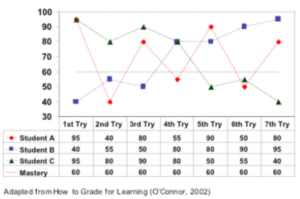
This graph illustrates three students who are packing parachutes over time. Mastery is noted at 60%. Technically, each of these students averages 70 percent, which is above mastery, but which student would you want to pack your parachute on the eighth try?
Students A and C have scores that move up and down throughout time, while Student B is consistently growing in their performance over time, and the last four tries for that student were consistently above the 60 percent threshold for mastery. This example is much like grading for learning. We desire to see a student’s knowledge grow through time instead of varying between high and low performances.
Educators never stop learning; check out our available graduate degree programs to hone your skills and promote lifelong learning and academic excellence.