
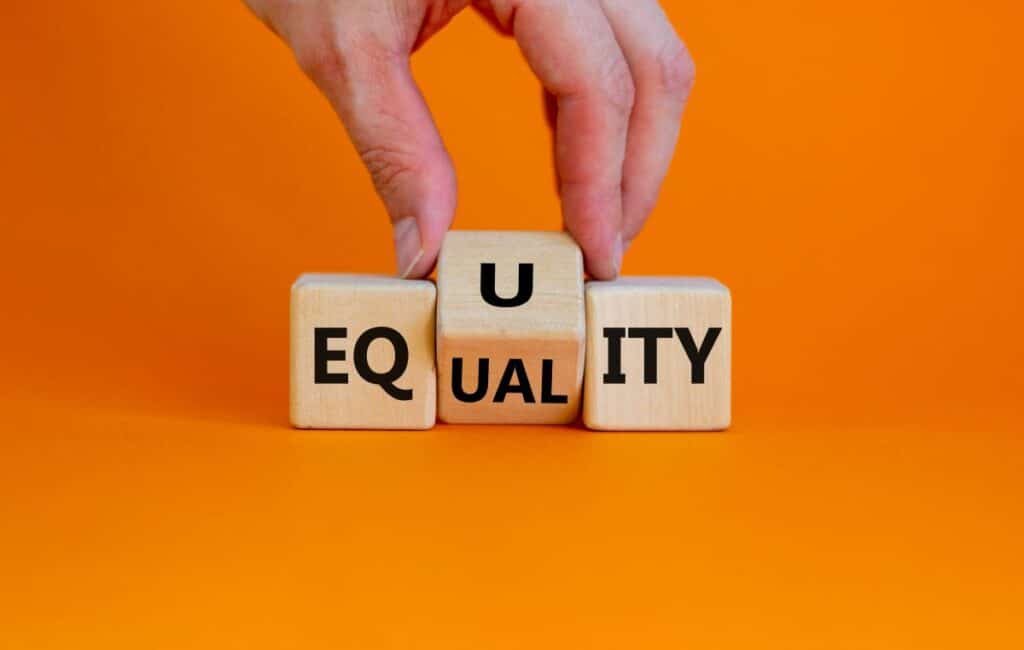
All children in the United States are given the equal right to receive a public education no matter what their gender, race, religion, ethnicity, or socioeconomic status is. However, it is essential to understand that when equality is ensured in the schools, we must ensure it is equitable.
Equity in Education
Equity recognizes that each person has different circumstances and needs, meaning different groups of people need different resources and opportunities allocated to them. This is a fundamental principle in education. Educators know that each child deserves specific opportunities, depending on their situation.
It may be a hard concept to explain or for people on the outside looking in to grasp, but this idea is practiced daily in our schools. A prime example of equity in education is the educational experience for those with learning difficulties or other obstacles. These students will typically receive special services or accommodation within their peers’ equal school environment.
Equality in Education
Equality in education has always been a difficult process in our history. From one-room schoolhouses to segregated schools, the idea of equality has always proven to be a difficult subject to broach. Our American history contains a difficult time in education where cultural norms and expectations created “separate but equal” beliefs and concepts that divided students based on the color of their skin. However, most researchers and historians will explain that “separate but equal” was often “separate and unequal.”
Equality in education simply means that every student receives the same resources and opportunities. Equality surrounds large ideals and beliefs, such as every school receiving the same funding, the same quality or number of materials, the same access to facilities, and in general, the same instructional practices. However, equality differs in this example: all students receive an electronic device, but not all students have internet at home. The school is providing equal access, but fairness is lacking because not all students have the internet at home.
Equity vs. Equality: The Differences
The difference between equity and equality can be confusing. Some people use the words interchangeably, but these words are not synonymous. Equality is when all people or students are given the same opportunities and the same support to reach a common goal. A common example is giving all children a box to stand on to watch a game happening over the fence. A problem arises when only equality is considered. Because does a small child have the same outcome of watching the game when he receives the same height box as a teenager to see over the fence?
The child certainly will not be able to see because it is much too short. Although giving everyone a box to stand on to see is a wonderful thought, the children are being treated with equity. Because they are not all able to have the same outcome – to see the game.
Equity, on the other hand, thinks about equality but goes one step further. Equity considers the differences among all involved and provides varying levels of support to ensure fairer outcomes. In the same box at the ballpark example from above, equity would be achieved if all children were given boxes of different sizes so that they can all see over the fence.

Looking for a graduate program?
Why the Differences Matter
Knowing the difference between equity and equality can be the key to helping all students reach the same goals and outcomes. Because more than educational equality is needed for students to achieve these goals. Educational equity acknowledges that students have different background experiences and learning styles and can help resolve issues faced by disadvantaged students. Equity makes sure that the equal opportunities given to everyone are modified for those who might need extra support.
Why Equity and Equality are Essential in Schools
Schools in today’s educational system all strive to adhere to the same foundational goals and ideals. The main foundation of any school is to provide an education to students and prepare
them for life after high school. However, the way that schools go about this concept or what that looks like varies greatly by the type of school, location, and other factors. Today, there is much discussion about equity and equality in our school systems, and the impact those ideas have on the current state of education, as well as the future of education.
First, to understand why these terms are important, we must clearly define them. Equity involves the belief that things are fair and impartial. Equality is the state of being equal, especially in status, rights, or opportunities. Over the last several years, the idea of equity and equality has gained significant traction across the country as various social and racial justice movements have gripped our nation. At the heart of each movement is the idea that individuals or groups are given the same resources and opportunities, regardless of their circumstances, which is equality in its most basic form. There are very few places where equity and equality play out each day more than educational systems.
At face value, equality shouldn’t be hard to accomplish. It is a very simple concept in that everyone gets the same. However, our schools are woefully unequal, meaning that equity becomes a fundamental concept to practice. In schools today, equity is the one variable that we as educators can control.
We can choose to ensure that our most vulnerable population receives what they need to be successful, regardless of equality discrepancies. Although these terms are used interchangeably, we must understand the distinction between the two, with equity being our overall goal as educators. As school leaders, coming to terms with the idea that we will never have equality is an important step as we shift our focus and mindset on what we can control, which is the belief that equity is the answer to supporting every student.
Equity and equality must be present in all schools. All students have to be given the same opportunities and the same experiences. In addition to equality, teachers, principals, and staff need to be aware of the differences among the student population. Just because all students are given a chance to take Algebra 1 does not mean that it is equitable. Students with interrupted formal education (SIFE) might need Pre-Algebra first. English language learners need to have more visuals and the opportunity to use their first language while learning algebra.
Accommodations and modifications to curriculum and activities will provide the supports that students need to overcome barriers that they may have to engage in the curriculum like their classmates. Equity focuses on differentiating supports based on the needs of each individual student. Just like Universal Design of Learning (UDL) provides multiple means of representation, action and expression, and engagement, educators should analyze the needs of their students and provide varying types of instructions and opportunities for students to show their knowledge. While doing this, varying the levels of support given to each student based on his/her unique needs will ensure equity.
Equity is achieved when students receive the resources that they need as individuals to reach the same outcomes as their classmates, whether it is in academic classes or the overall goal of graduating high school. Knowing that a school provides all students with equal opportunities is not enough. Educators want to guarantee that students have equitable access to these equal opportunities.
Educators never stop learning; check out our available graduate degree programs to hone your skills and promote lifelong learning and academic excellence.