
What is Hexagonal Thinking?
Hexagonal thinking is a visual way for teachers to help students to analyze, problem-solve and think outside the box, all within the classroom setting. This process encourages students to think critically, make specific connections and provide different kinds of evidence to support their thoughts and reasoning. Hexagonal thinking requires a visual aspect to demonstrate its purpose.
Typically, there are a series of hexagons that connect to demonstrate the point to the student and the different ideas, etc. The hexagon tiles will connect to a central idea or theme that is stated on one tile. In return, students will demonstrate their understanding through their connections, debates, and evidence to support their reasoning.
Why Hexagonal Thinking Can Be Beneficial
Connect Thoughts/See Other Points of View
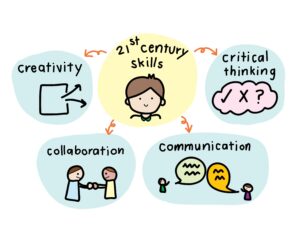
A major purpose of using hexagonal thinking within the classroom is to help students connect their thoughts and ideas to the topic area or theme of the lesson and see other points of view. This can help better student understanding. It helps students to put their thoughts and ideas together to create a bigger picture of the topic area. Hexagonal thinking can be very beneficial within the classroom. It can help encourage student collaboration as well as communication skills.
Communication Skills
It helps to build those skills as students can work together to arrange their tiles and will need to understand each other’s points of views to create their design. It also can help build on students’ communication skills because students will have to explain the connection between their tiles and defend their stance, which essentially is their understanding of the topic area. When students explain their thoughts and ideas, it could demonstrate a different perspective to their peers, which can then lead into a further discussion and more communication between students.
Analytical and Critical Thinking
Hexagonal thinking also helps students solve problems and challenges them to think analytically and critically on the topic area. The activity of hexagonal thinking provides a way for students to take one topic, one problem, or one issue and break it down into smaller parts or pieces. The connecting tiles can help students make sense of the overall topic by looking at the smaller parts that create it, thus providing students a better sense of what they are learning. Students have to put time and effort into the process as well as have a good understanding of the topic area.
How to Incorporate Hexagonal Thinking in Your Classroom
Hexagonal thinking can be incorporated into any classroom. It can be done at many ages and grade levels. The lower grade levels could require more work for the teacher but will still be effective.

Looking for a graduate program?
Lower Grade Levels
For lower grade levels, teachers can write the different words, topics, or ideas on different hexagonal tiles and have students arrange the tiles as they think they should go. Students can then explain why they connected the tiles in the manner that they did, demonstrating their understanding of the topic area.
Higher Grade Levels
As the grade levels get higher, in middle school and secondary school, the teacher can put certain words on tiles and have students create their own to connect to the main theme. Hexagonal thinking can be used at the beginning of a lesson to determine what students already know or to activate prior knowledge of a topic area. It can be used during the lesson to check for understanding such as a formative assessment would. Or it can be used at the end of a unit as a summative assessment or to prepare for a summative assessment.
Hexagonal thinking can also be used to deepen understanding of topics, practice vocabulary, or make connections from the classroom to the real world. When using hexagonal thinking in the classroom, the students can connect tiles to each side of the hexagon. Since a hexagon has six sides, it allows for multiple connections that students can make and build upon depending on the way that hexagonal thinking is used within the lesson. Students will start with one hexagon and build and build to create a larger object to demonstrate their understanding.
High School English Class Example
There are many hexagonal thinking examples but this in specific could work in a high school English class reading the novel Of Mice and Men. Students could create tiles corresponding to the different themes of the novel. Tiles can have character analysis, facts about the Great Depression, biographies of migrant farm workers, and much more to connect the story to real life events. These tiles can be worked on individually or in groups.
High School Algebra Example
Whereas in a high school algebra classroom, hexagonal thinking may be used as a way to practice and review concepts such as factoring or multiplying binomials or polynomial expressions.
Students can receive one hexagonal tile with a polynomial expression from the teacher and use it to multiply and get a result. Each answer would connect and build as students solve more. The tiles will only connect if, and when, students solve correctly. After students are done solving, other students can either correct or learn from each other. The teacher can individually correct the student’s work or have students walk from desk to desk or area to area — similar to a gallery walk — correcting or learning from their peers’ work.
Online Templates
There are many online options for a hexagonal thinking template to help teachers get started using hexagonal thinking in the classroom. Some of these templates have lessons connected to them or a teacher can simply create their own. It is important to demonstrate to students the point of each tile and the concept of hexagonal thinking. Students need to understand the purpose of what they are doing. This ensures authenticity within the lesson. The main point of using hexagonal tiles is to ensure that hexagonal thinking is reinforcing student understanding. The different maps that students create will help promote classroom conversation and quickly assess student understanding.
Hexagonal thinking is a different way to engage students, generate collaboration and conversation, develop problem-solving skills, and get students to move within the classroom.
Teachers never stop learning; check out our available graduate degree programs to hone your skills and promote lifelong learning and academic excellence.