Universal Design for Learning (UDL) is a comprehensive approach to meeting the needs of all students for a more equitable and engaging classroom experience. The UDL classroom can be very beneficial for students with learning delays and behavior challenges.
According to Higher Education Opportunity Act of 2008, the universal design for learning definition is a scientifically valid framework for guiding educational practice that provides flexibility in the ways information is presented, students are engaged, and students respond or demonstrate knowledge and skills. This reduces barriers in instruction, provides appropriate accommodations, supports, and challenges, and maintains high achievement expectations for all students, including students with disabilities and students who are limited English proficient.
The UDL framework, first defined by David H. Rose, Ed.D. of the Harvard Graduate School of Education and the Center for Applied Special Technology (CAST) in the 1990s, calls for creating curriculum from the outset that provides:
- Multiple means of representation to give learners various ways of acquiring information and knowledge
- Multiple means of expression to provide learners alternatives for demonstrating what they know
- Multiple means of engagement to tap into learners’ interests, challenge them appropriately, and motivate them to learn
At its core, Universal Design for Learning consists of three principles rooted in brain-based processing research that include:
- Affective Networks: The “why” of learning which relates to engagement;
- Recognition Networks: The “what” of learning which relates to representation; and
- Strategic Networks: The “how” of learning which relates to action and expression (CAST 2018).
As shown in the graphic on the CAST website, each component is divided into three smaller subsections that are aligned with the pedagogical principles of accessing, building, and internalizing knowledge for individual learners. Each subcategory then contains a series of three checkpoints that are further explained and then applied to a classroom learning environment culminating in the bottom “internalizing” tier checkpoints of self-regulation, comprehension, and executive function.
Self-Regulation
The concept of self-regulation, defined by CAST as “the ability to self-regulate—to strategically modulate one’s emotional reactions or states in order to be more effective at coping and engaging with the environment,” is a critical precursor to students’ development of a level of comfort when presented with new and challenging learning objectives (CAST 2018). This ability to self-regulate with regard to their approach to learning allows students to view potentially overwhelming objectives as steps in the curricular scaffold as opposed to insurmountable obstacles.
Naturally, much of students’ ability to demonstrate this type of self-regulation stems directly from the manner in which the instructor frames the introduction of new material over the course of the term or school year. The UDL framework provides specific examples of how intentional teachers may promote student ownership of success through personal goal-setting, managing their emotions related to learning and promoting awareness of goal-oriented progress as well as learning from mistakes.
Comprehension
Comprehension is perhaps the most familiar component of the UDL framework as it primarily addresses the pedagogical elements of sound teaching. This component is similar to other familiar learning designs and relies upon traditional principles such as accessing students’ prior knowledge, emphasizing big ideas, highlighting the relationships between various concepts, and incorporating visualization and multiple exposures to the thematic elements within the unit or lesson series.
CAST offers the following explanation of comprehension: “Constructing usable knowledge, knowledge that is accessible for future decision-making, depends not upon merely perceiving information, but upon active “information processing skills”,” (CAST 2018). Thus, comprehension remains the crux of the UDL framework.
Executive Function
Executive function, then, represents a level of mastery in which students are able to apply learned knowledge to more complex functions by reducing the amount of “brain energy” expended upon “lower level” conceptual processing. Executive function is the highest level within the scaffolded approach in which students are able to apply their knowledge to additional complex learning without the need to go back and revisit fundamental concepts. This component of the UDL framework again focuses upon advanced goal-setting fostered by the instructor in addition to instructor-modeled memory training and ongoing progress monitoring.
Universal Design for Learning Examples in the Classroom
Lesson Goals
Students is a UDL classroom know what goals have been set for them. These goals are not only discussed but clearly posted in student-friendly terms. These goals are also referred to during the lessons for relevance and to help students make connections.
Assignment Options
In traditional classrooms, all students have one assignment structure. UDL classrooms offer multiple ways for students to show their understanding.
Examples of this are choice boards with various types of projects and ideas. Along with the common assignments, there can be options to:

Looking for a graduate program?
- Record a video or podcast
- Craft a song or rap
- Make a drawing or a comic strip
- Design their own model
- Teach a mini-review lesson to the class
Flexible Work Spaces
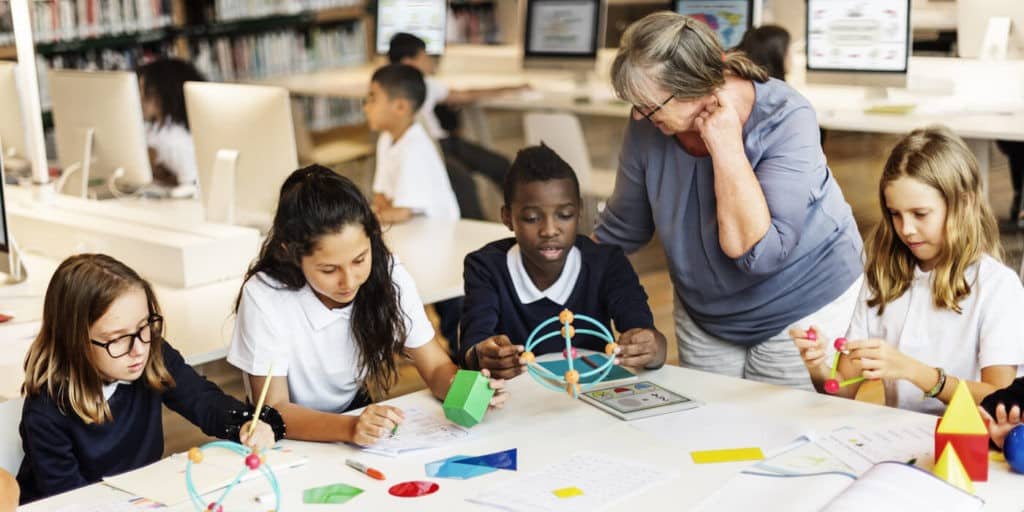
Classrooms today do not look or feel like classrooms in the past. They are starting to be set up with more of a home feel; teachers want students to be comfortable to be their best selves during instruction. In a UDL classroom, learners have the choice to sit in a space for group collaboration with a whiteboard table or individual work.
There are spaces with bean bags and pillows. You may even see a couch, rugs that feel like home and other décor that brings comfort. Outside of the workspaces, there may be gadgets for the students to use such as headphones, iPads and, other technology to access knowledge and make learning easier.
Group Work
Group work has always been common in classrooms but in a UDL setting, groups could be based on learning preferences or the assignment choice. Students have commonalities for a stronger collaboration. On the other hand, you could group students by their strengths to ensure all aspects of the assignment are completed well. Students would need to know their learning style and strengths, so having them complete a learning preference survey or personality type survey is beneficial.
Digital and Audio Text
Some students need additional support in learning today. UDL in comprehensive for all students and their specific needs.
Having options for text to be read to students, such as audiobooks and text-to-speech technology levels the playing field. There could be captions, transcripts for audio, options for enlarging text, and adjusting the color or contrast on a screen.
Frequent Feedback
Consistent feedback is key in all classrooms. Feedback in a UDL space is given daily and multiple times during the day. Teachers give students the time to reflect at the end of each lesson and provide feedback on how they are progressing.
Benefits of Universal Design for Learning
UDL benefits all children in every setting because of its laser-like focus on the needs of the students. There is no stone unturned that is not considered to make learning personalized. UDL reminds me of a learning plan or an individual education plan.
Those are explicitly written for a student with a cognitive or behavioral delay and challenge. Traditionally these plans are only written for specific learners. UDL provides this detailed learning plan for all the children involved, propelling them in their educational experience.
How Did COVID Impact Universal Design for Learning?
The COVID-19 pandemic brought about rapid change for all those involved in education. Parents were worried about how they could care for their children while ensuring their learning needs were met. Students had to adjust to a new style of teaching and learning.
They also adapted quickly to working more independently. Teachers had to completely change gears with lesson design and convert to online teaching strategies that would hopefully yield growth and proficiency. This change was not natural and was shocking to many.
Some students struggled with technology connectivity or just obtaining a device or a device of their own to use for school. Student had to learn self-discipline and organization for lessons and assignments. Students lost connections with their peers during school closures, increasing loneliness, anxiety, and depression.
Another important effect was the loss of language and speech development for our youngest learners who need to be close to their teachers and see the formation of their mouth when speaking and learning letter sounds, etc.
The COVID-19 pandemic made use of some of the UDL strategies unattainable. The possibilities inside a brick-and-mortar learning space were great. Many innovative practices have emerged but needed to be teacher lead and face-to-face. Activities such as face-to-face group work, specific classroom learning options, and the use of flexible learning spaces were abandoned.
Although some of the strategies could not be explored virtually, there were still creative ways to engage students and offer multiple ways to acquire and express information. Teachers needed to be innovative and think outside the box to give as much fidelity to the UDL approach as possible.
Interested in obtaining your graduate degree? Explore 190+ available masters, doctorates, endorsements, and certifications to advance your career today